

Your Taxi May Not Reach Your Riad: How Medina Arrivals Actually Work in Marrakech

Your taxi may not be able to take you to the front door of your riad in the Marrakech Medina. That is normal, but it surprises a lot of first time visitors because a hotel address looks like any other address on a booking page. In the old city, the map pin and the point a car can physically reach are often two different places.
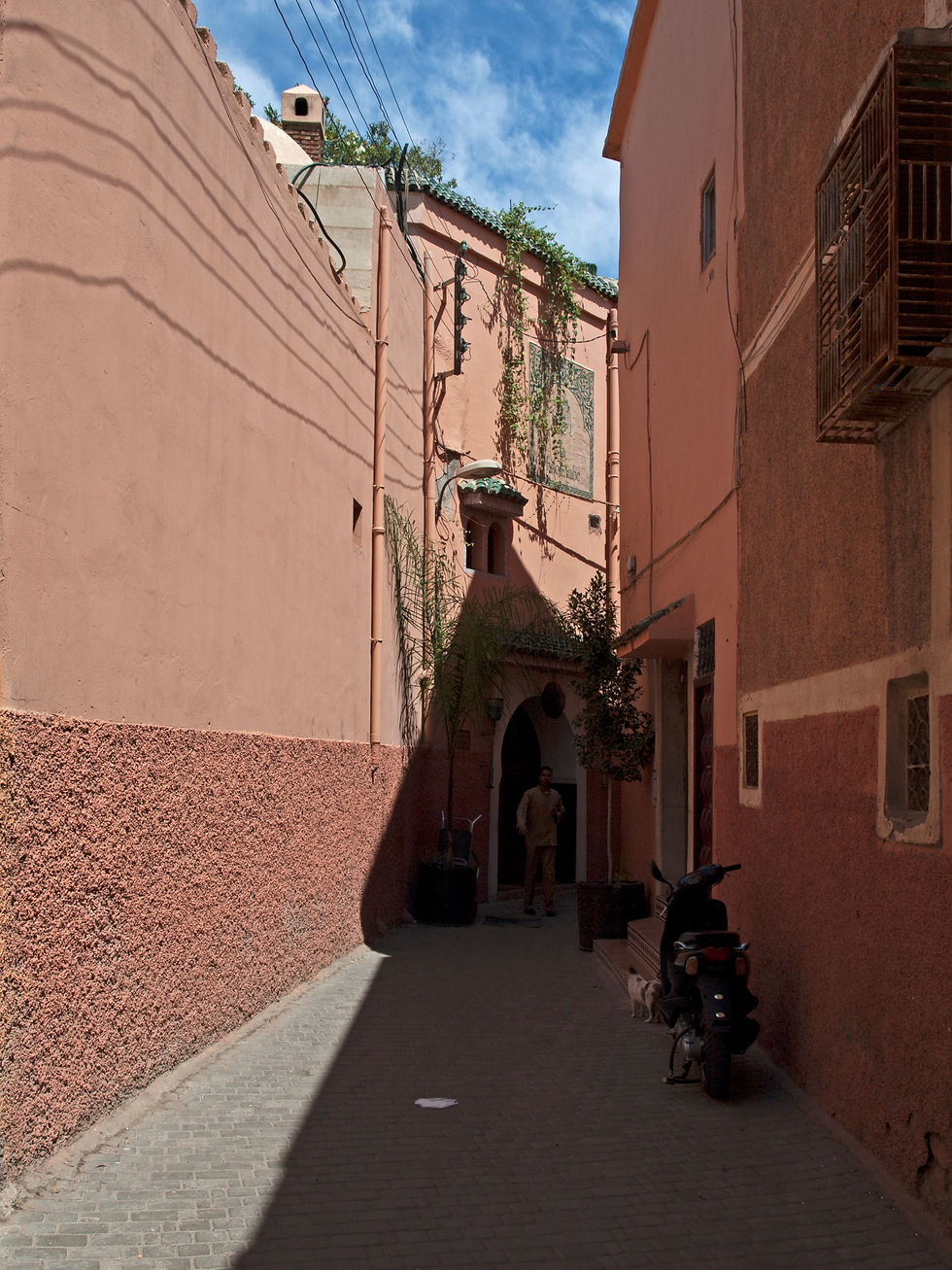
Photo: Ymblanter, Wikimedia Commons, CC BY SA 4.0. License: https://creativecommons.org/licenses/by-sa/4.0/
The useful thing to understand is that there is no single Medina arrival experience. Some riads sit on streets a car can enter. Some are a one or three minute walk from a taxi point. Others are deeper inside pedestrian lanes, where the final approach has to be made on foot. The difference matters most when you are arriving after dark, carrying large suitcases, traveling with children, helping an older relative, using a wheelchair, or checking in after a long flight.
This guide is about that last part of the journey. It is not about whether riads are good places to stay. It is about knowing exactly what happens between the moment your taxi stops and the moment you are standing at the riad door.
Why the Medina works this way
The Medina was built long before cars. Many streets are narrow, many smaller lanes are pedestrian, and a route that looks perfectly continuous on a phone can become too tight for a regular vehicle. A driver may therefore stop at a gate, a square, a parking area, or the nearest wide street.
That does not mean the riad is badly located. In fact, some of the most attractive riads are hidden precisely because they are inside older residential quarters. The tradeoff is that the last part of the trip may be on foot.
The important distinction is between the hotel address and the vehicle access point. The hotel address tells you where the door is. The access point tells you where the taxi can leave you.
Three types of riad access
The clearest way to think about Medina access is to divide riads into three groups.
The first group has direct vehicle access. This is less common inside the old city, but it exists. Riad Ayadina, near Bab El Khemis, explicitly says that a car can reach its door. This is the easiest arrangement for heavy luggage, limited mobility, very late arrivals, and families with small children.
The second group has near door access. The taxi gets close, but the final stretch is on foot. Riad Vendôme, near Bab Doukkala, describes a roughly 100 metre final walk from the car area. That is a very different situation from being dropped ten minutes away. A short, flat walk may be completely fine for most travelers, while still being something you want to know before landing.
The third group is the classic deep Medina arrival. A car stops at a known access point and a staff member walks you through the lanes. Dar Nour el Houda, near Ben Youssef, tells guests that cars come no closer than Place du Mokef and that someone from the house meets them there and carries the bags.
All three can be perfectly good places to stay. The problem starts when a traveler assumes they are all the same.
The one question to ask before booking
If access matters to you, do not ask, "Is the riad accessible by car?" That wording is too vague.
A property can honestly answer yes because cars reach the neighborhood, even when they do not reach the door.
Ask this instead: "Can a regular taxi drive directly to the main entrance of the riad and drop us at the door with our luggage, without any walking?"
If the answer is no, ask one more question: "How many minutes do we walk from the taxi drop off point, and will someone meet us there?"
Those two questions remove most of the uncertainty.
Do not assume Google Maps knows where the taxi should stop
Navigation apps are useful inside Marrakech, but they are not designed to explain the practical difference between a pedestrian derb, a lane wide enough for a motorbike, and a street a taxi can use.
A map can show the precise location of the riad door and still give you no useful information about the nearest car access point.
That is why the name of the meeting point matters. A good arrival instruction usually sounds like "meet us at Bab Doukkala", "stop at Place du Mokef", "call us from the parking area", or "our driver will call the riad when you are close."
Save that meeting point separately from the hotel pin.
Why the riad transfer can be worth paying for
An airport transfer arranged by the riad is not automatically necessary. A normal taxi can get you into the Medina area. But the transfer can solve a problem that is easy to underestimate: coordination.
A driver working with the riad already knows where the vehicle journey ends. The property knows which driver has you. Staff can be waiting at the correct point. If the last section is pedestrian, someone can take over from there.
That convenience becomes more valuable after dark, on your first visit, or when you have several bags.
If you take your own taxi, send the riad your estimated arrival time anyway. Ask for the exact drop off location in writing and keep the property's phone or WhatsApp number available.
What to do at Marrakech airport
Before leaving the airport, make sure you have three things saved on your phone: the riad name, the exact meeting point, and a phone number that works on WhatsApp or normal calls.
If the riad has arranged a driver, send your flight number in advance. Flight delays are easier to manage when the property knows which flight you are on.
If you are taking a regular taxi, show the driver the meeting point rather than only the riad address. A driver may know Bab Doukkala, Bab El Khemis, Place du Mokef, Dar El Bacha, or another well known access point immediately, while the name of a tiny derb may mean nothing.
Keep your luggage together when the car stops. If a riad employee is supposed to meet you, call the property before following anyone else who offers directions.
Porters and luggage
If your riad is several minutes inside the Medina, luggage help is not a luxury in the way a hotel bellhop can feel like a luxury. It can be part of the transport chain.
Rolling a large suitcase over uneven paving, around scooters, through narrow corners, and across busy market lanes is possible, but it is not always pleasant. Two smaller bags are often easier than one enormous case.
Many riads arrange someone to meet guests and help with luggage. Confirm whether that is included or whether a porter may expect payment. Do not assume either way.
If an independent porter helps you, agree on the price before setting off. That avoids turning a simple arrival into an awkward negotiation at the door.
Late night arrivals need a different plan
A route that feels obvious at 2 in the afternoon can feel completely different at midnight.
Some shops are closed, familiar landmarks disappear behind shutters, and the small lane containing your riad may have very little signage. This is the worst time to improvise.
For a late arrival, I would prioritize coordination over saving a small amount of money. Arrange the riad transfer if the price is reasonable, or at least arrange for a staff member to meet your taxi at a named point.
Send a message before the flight takes off. Ask whether reception will still be staffed at your arrival time. Ask whether someone will physically meet you at the taxi point.
You want your first walk through the Medina to feel interesting, not like a luggage based escape room.
Families with children
For families, the biggest issue is not usually distance. It is managing people and luggage at the same time.
A five minute walk is easy when two adults are carrying backpacks. The same walk becomes much more complicated with a sleeping child, a stroller, two suitcases, and hand luggage.
Ask whether the path from the taxi point has stairs or unusually narrow sections. Ask whether staff can help with bags. If you use a stroller, ask whether the final approach is realistically stroller friendly rather than merely technically possible.
If your children are very young, direct car access or a very short final walk can be worth prioritizing even if the riad itself is slightly less central.
Older travelers and reduced mobility
This is where vague descriptions such as "central", "easy access", and "near the taxi" become unhelpful.
Ask for distance in metres or minutes. Ask about steps. Ask about the surface. Ask whether the riad itself has rooms on the ground floor, because even after reaching the door many traditional riads rely on stairs and do not have lifts.
Riad Vendôme, for example, publishes specific information about its flat final approach and which areas inside are step free. Riad Ayadina emphasizes direct car access. Those are the kinds of concrete answers to look for.
A beautiful riad is not a good booking if the arrival route makes the trip physically difficult for someone in your group.
Rental cars and Medina parking
If you are driving into Marrakech, do not plan to use the riad door as if it were a normal hotel driveway unless the property explicitly confirms that this is possible.
Ask the riad which gate or parking area to use. Ask whether parking is guarded, whether it is paid, and how far it is from the property.
If you are using the car for day trips, think about the departure as well as the arrival. A riad that requires a long walk to parking can be charming for a city break but inconvenient if you plan to leave Marrakech by car every morning.
This is one reason the "best location" is different for different travelers.
Departure mornings deserve planning too
The arrival gets all the attention, but the departure can create more stress because there is a flight or train to catch.
If a taxi cannot reach the riad, decide the night before where it will meet you. Ask staff what time you should leave the property, not only what time the taxi is booked.
Build in walking time and a margin for loading luggage. If a porter or staff member will carry bags, arrange that before going to bed.
For an early flight, the safest arrangement is usually for the riad to organize the car and the handoff, especially if the final pedestrian section is long.
A useful arrival message you can copy
You do not need a long email. Send the property something like this:
"Hello, we arrive in Marrakech on flight [flight number] at [time]. Can a regular taxi reach your front door? If not, please send us the exact taxi drop off point, the walking time from there, and confirm whether someone can meet us and help with luggage."
If mobility matters, add:
"One traveler in our group has difficulty walking long distances and using stairs. Please tell us the exact walking surface, any steps on the approach, and whether a ground floor room is available."
That message is much more useful than asking whether the hotel is "easy to reach."
How to judge a riad listing before you book
Look for practical language. "Taxi to the door" is clear. "100 metres from car access" is clear. "Meet at Place du Mokef" is clear. "Central location" tells you nothing about luggage.
Zoom out on the map. See which city gate, square, or major street is closest. Read recent guest reviews specifically for words such as taxi, luggage, difficult to find, car, parking, transfer, stairs, and arrival.
Then contact the property directly if the answer is still unclear.
The point is not to avoid hidden riads. The point is to know what kind of arrival you are buying.
The best first arrival is boring
This sounds strange, because Marrakech is supposed to feel exciting. But your first twenty minutes after a flight are not the moment you need an adventure.
A boring arrival means the driver knows where to stop, someone is waiting, your bags are handled, and you reach the riad without negotiating directions while tired.
You will have plenty of time to get lost in the Medina later, when you are doing it on purpose.
Quick answers
Can taxis drive everywhere in the Marrakech Medina? No. Vehicle access varies by street and neighborhood, and many smaller lanes are pedestrian or too narrow for a regular taxi.
Does every riad require a walk from the taxi? No. Some have direct car access, some are a short walk away, and some require a longer pedestrian approach.
Should I book the riad airport transfer? Not always, but it can be especially useful for a first visit, late arrival, heavy luggage, children, or reduced mobility because it coordinates the driver with the property's meeting point.
What should I ask the riad before booking? Ask whether a regular taxi reaches the front door. If not, ask for the exact walking time, surface, stairs, meeting point, and luggage assistance.
Can I trust the map pin? Trust it for the riad's location, not automatically for vehicle access. Ask for the actual taxi drop off point.
The bottom line
A hidden riad is one of the pleasures of staying in Marrakech. You step away from a busy street, pass through an ordinary looking door, and find a courtyard that feels completely separate from the city outside.
The hidden part is charming once you are checked in. It is less charming when you discover it for the first time with twenty kilos of luggage.
Before you book, find out where the car stops. Before you fly, save the meeting point. Before the taxi leaves, make sure the riad knows you have arrived. That small amount of planning removes one of the most common and completely avoidable stresses of a first stay in the Medina.

Comments