
Marrakech Rugs & Weaving Tour
For centuries, Moroccan families have passed the craft of rug making from one generation to the next, carrying forward techniques, symbols, and regional identities through wool, dye, and knot. This tour is built for travelers who want to understand that inheritance before they ever consider owning a piece of it. Your guide walks you through the souks and workshops where these traditions are still alive today, explaining the origin, meaning, and craftsmanship behind each piece so that what you see becomes something you truly understand, not just something you look at.
DURATION
4 Hours (Half-day)
LANGUAGES
English, French, Spanish, Arabic
GROUP TYPE
Private Only
GUIDE
Official Licensed Local Guide
STARTING POINT
Flexible (Riad, Hotel, Jemaa el-Fna)
CUSTOMAZIBLE
Yes
Travelers who see a rug as an art form, not just a decoration, and want to understand the craft, symbolism, and regional traditions behind it
Anyone planning to buy a rug, whether it is one meaningful piece for a spare room or a significant purchase for a home, and wants to buy with real knowledge rather than guesswork
Interior designers, collectors, and buyers looking for pieces with genuine provenance and honest quality assessment
Textile and craft enthusiasts curious about natural dyeing, hand spinning, and traditional weaving techniques still practiced today
Couples and families who want a relaxed, private introduction to this part of Moroccan culture, at their own pace
Who Tends to Book This Tour
The Experience
A Moroccan rug is not one tradition but many, and where a rug comes from tells you almost everything about what it is. The plush, undyed ivory wool of a Beni Ourain, woven by communities of the Middle Atlas, was originally made for warmth in the mountains, not for a showroom floor, which is why its geometry is restrained and its wool so dense. An Azilal rug, from the Central Atlas, tends to be freer and more colorful, with abstract lines and asymmetry that reflect the hand of the individual weaver rather than a fixed template. Boujaad rugs, from the plains west of Marrakech, are known for their vivid pinks and reds, often tied to marriage and household symbolism. Rugs from the Zayane and Zemmour communities of the Middle Atlas tend toward a structured red ground with sharp, repeating motifs.
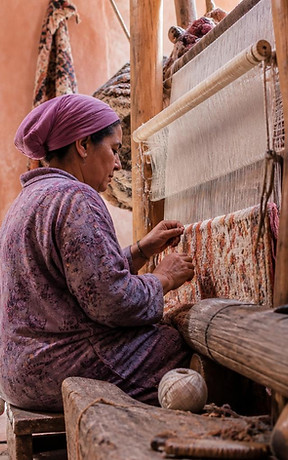
Understanding a rug also means understanding how it is made. Hand knotted rugs, tied knot by knot around a warp thread over weeks or months, are structurally different from flatweaves like the kilim or hanbel, which have no pile at all, and both are different again from a machine made copy that can imitate the look of either in a fraction of the time. Wool quality, knot density, and the use of natural dyes such as saffron, indigo, madder root, and walnut husk, versus synthetic ones, all affect how a rug looks, feels, and ages, and none of it is obvious to an untrained eye. The geometric motifs themselves, diamonds, zigzags, stylized eyes and hands, often carry meaning related to protection, fertility, or identity, though the specific meaning can vary from weaver to weaver and village to village, and a good guide will tell you honestly where that knowledge is well established and where it is more a matter of tradition and interpretation.
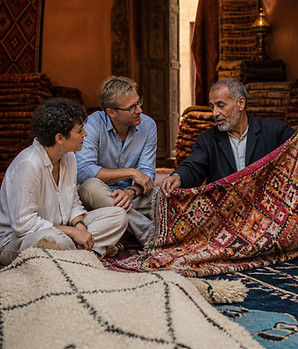
This is what your guide walks you through in person, not as a sales pitch but as context you can actually use. In the dyers' souk you watch wool and silk being dipped into vats of natural and mineral pigment and learn to tell a hand dyed skein from a chemically dyed one. In the carpet souk and in private ateliers, your guide unrolls pieces with you, points out what marks genuine hand knotting, explains what a fair price actually looks like for the size, material, and origin of a given rug, and stays by your side through any conversation with the seller, so that if you do decide to buy, you are doing so with someone in your corner who has no reason to inflate the price and every reason to make sure you leave satisfied.
Choose Your Day
This itinerary is a sample starting point. Your interests shape the day, whether you’re drawn to a particular region, curious about a specific technique, or looking within a certain price range. Tell us what you’re looking for in advance, and we’ll shape the experience around you.
Half Day Itinerary — 4 Hours
09:00
Meeting Point and Orientation
Your guide meets you at Jemaa el-Fna, or at your riad or hotel if you prefer. Before entering the souks, you receive a short orientation on the structure of Marrakech's textile trade, how it is organized by region of origin and by cooperative, and why that structure matters to understanding what you are about to see.
09:30
Souk Sebbaghine
The dyers' quarter, where wool is still treated using both traditional plant based pigments and modern dye methods. Skeins of freshly dyed wool hang overhead in deep reds, indigos, and saffron yellows. Your guide explains how dye choice affects a rug's longevity, color depth, and value, and how to spot natural dye by eye.
10:15
Souk Zrabi
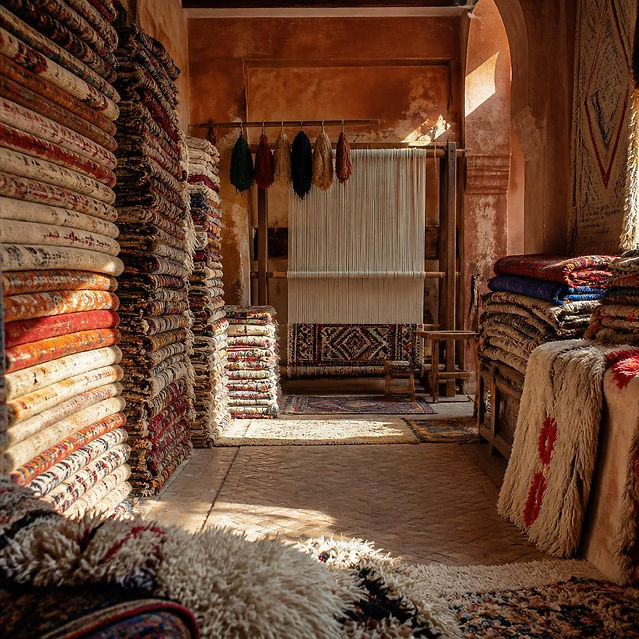
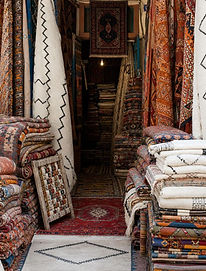
The rug souk itself, stacked floor to ceiling with pieces from across Morocco. Here your guide walks you through the regional distinctions in person, Beni Ourain, Boujaad, Azilal, and others, teaching you to identify knot density, wool quality, and weave irregularities that indicate handwork.
11:00
Ateliers in the Medina
Visits to working ateliers, where you see rugs in earlier stages of production, from raw wool to loom, and speak directly with artisans about technique and design. Depending on your interests, these stops can be adjusted toward a specific region, dye tradition, or style.
12:30
Extension Based on Interest
The remaining time is shaped entirely around what you are looking for. Some travelers want to see a cooperative outside the medina walls. Others want more time comparing pieces before making a decision. Let your guide know what you are hoping to find, and the rest of the day follows that interest.
What You Will Experience