

Marrakech Palaces and Architecture Tour
Marrakech has been rebuilt, embellished, and fought over by five different dynasties, and each one left its own signature in stone, cedar, and tile. This tour walks you through the palaces, the madrasa, and the workshops where that history is still readable today, with a guide who can explain not just what you are looking at, but why it was built that way.
DURATION
4 Hours (Half)
LANGUAGES
English, French, Spanish, Arabic
GROUP TYPE
Private Only
GUIDE
Official Licensed Local Guide
STARTING POINT
Flexible (Riad, Hotel, Jemaa el-Fna)
CUSTOMAZIBLE
Yes
Travelers who appreciate fine architecture and want a knowledgeable guide to explain the history, materials, and techniques behind it, not just admire it in passing
Anyone with an interest in Islamic geometric design, carved wood, tilework, or Moroccan decorative arts, whether or not they have prior background in the subject
Visitors who want to understand how successive ruling dynasties, over nearly a thousand years, each left a distinct architectural mark on the same city
Travelers who want to see the connection between what's inside a palace and what's being made by hand a few streets away, and understand why that connection exists
Couples, families, and solo travelers who want a private, unhurried pace with a guide who can go as deep, or as light, as they'd like
Who Tends to Book This Tour

The Experience
Marrakech was not built once. It was built in layers, by five successive dynasties, each of which left its own architectural signature on top of the last: the Almoravid founders who laid out the city in the eleventh century, the Almohads who built the Kutubiyya minaret and set the model for every minaret in the city after it, the Marinids who founded Ben Youssef Madrasa as a center of learning, the Saadians who rebuilt the madrasa and raised El Badii Palace at the height of their power, and the Alaouites, whose vizier Ba Ahmed built Bahia Palace in the final years of the nineteenth century.
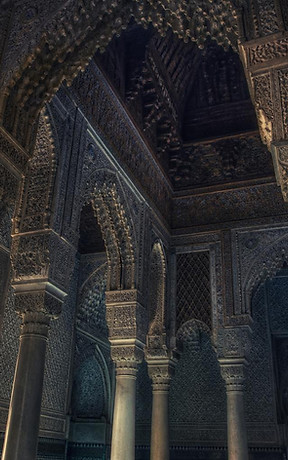
Your guide walks you through this sequence at the monuments themselves, using the correct terminology for what you are looking at: zellige, the mosaic tilework cut piece by piece from glazed clay tiles into star and geometric patterns; jbis, the hand carved plasterwork covering walls and archways in vegetal and calligraphic relief; muqarnas, the stalactite like clusters that resolve a square room into a round dome overhead; and the carved and painted cedar ceilings brought down from the Atlas Mountains that cap almost every important room in the city.
The tour then moves into the souks that produced, and still produce, these same materials. This is not a shopping stop bolted onto a monument visit. It is the other half of the same story: the carved doors you saw in the palace were made by craftsmen whose direct professional descendants are still carving cedar a few streets away, using largely the same tools and the same design vocabulary. Seeing both halves in the same afternoon, the finished monument and the workshop where the technique is still alive, is what this tour is built around.

Choose Your Day
Each itinerary below covers a different approach to the city. Pick the one that fits your travel pace, and priorities.
Half Day Itinerary — 4 Hours
09:00
Meeting Point and Orientation
Your guide meets you at Jemaa el-Fna square for a short orientation to the medina's layout and the day ahead, covering how the monuments and souks on this route relate to one another historically and geographically.
09:30
The Saadian Tombs: The Architecture of Commemoration
Built in the late sixteenth century under Ahmed al-Mansur, the Saadian Tombs represent one of the most concentrated displays of decorative architecture in the city. The central mausoleum, known as the Hall of the Twelve Columns, uses muqarnas and carved marble to transition from a square chamber to a domed ceiling in a way that is considered one of the finest surviving examples of the technique in Morocco. The site has its own striking history: it was sealed off from view for centuries by a later sultan and only rediscovered in 1917, which is why its original decoration survives in such well-preserved condition. Your guide walks you through the site's architecture and the circumstances of its long concealment and rediscovery.
10:15
Bahia Palace: The Architecture of Private Life
From the tombs, a short walk brings you to Bahia Palace, built in the late nineteenth century for a powerful vizier rather than a ruling sultan. Unlike the ceremonial and commemorative architecture seen earlier, Bahia Palace was designed for daily domestic life, with garden courtyards, painted cedar ceilings, and walls carved with detailed floral plasterwork. Your guide identifies the specific techniques in use and explains how the decorative language shifts here toward comfort and privacy rather than grandeur.
11:00
Ben Youssef Madrasa: The Architecture of Learning
Ben Youssef Madrasa, an Islamic school first built in 1346 and rebuilt in the 1560s. Its courtyard combines zellige, carved plaster, and carved cedar in one unified decorative system, offering a final and complete counterpoint to the funerary architecture of the Saadian Tombs and the private domesticity of Bahia Palace.
11:45
Souk Semmarine and Souk Chouari: The Market Artery and the Wood Carvers
The tour continues into Souk Semmarine, the medina's historic main commercial artery, where your guide explains the deliberate relationship between the market's layout and the surrounding religious and educational buildings. From there, you move into Souk Chouari, the wood carvers' quarter, where cedar is shaped by hand into doors, screens, and furniture using techniques directly connected to the carved woodwork seen inside both the tombs and the palace.
12:30
Place des Ferblantiers and the Ironworkers' Quarter
A small square of ironworkers and lantern makers gives you a direct view of metalwork craftsmanship, hand-cut iron and brass shaped using the repousse technique, the same method behind much of the metal decoration seen throughout the morning.
What You Will Experience