

Marrakech Souks and Medina Tour
The Marrakech Souks and Medina Tour is our signature experience, a structured, private walk that connects the working souks of the medina to the palaces, mosques, and religious schools that sit only minutes away from them. Your guide moves between craft quarter and historic monument as one continuous story, not two separate outings. This is the tour for travelers who want the full medina, the trade and the heritage together, in a single well paced day.
DURATION
4 Hours (Half) or 8 Hours (Full)
LANGUAGES
English, French, Spanish, Arabic
GROUP TYPE
Private Only
GUIDE
Official Licensed Local Guide
STARTING POINT
Flexible (Riad, Hotel, Jemaa el-Fna)
CUSTOMAZIBLE
Yes
Travelers who want to see Marrakech's landmark palaces and religious schools without giving up time in the souks
Travelers who assumed they had to choose between a "sightseeing tour" and a "shopping tour" and are relieved to find they do not
First time visitors with only one or two days in Marrakech who want the essential medina in a single, well organized outing
Visitors who admired a palace ceiling, a courtyard door, or a tiled fountain somewhere in the medina and want to understand where that craftsmanship comes from and whether they can see it being made
People who want an actual guided introduction to Marrakech's history, not just a list of stops, delivered by someone who can move fluently between the royal architecture and the market economy that surrounded it
Who Tends to Book This Tour

The Experience
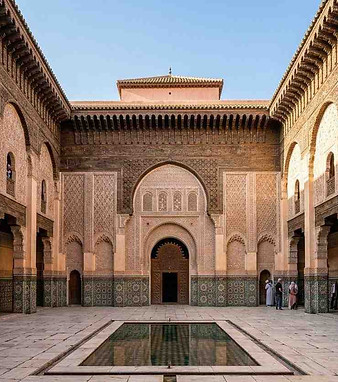
Marrakech's monuments were not built in isolation from its markets. The zellige tilework covering a courtyard in Bahia Palace was cut by the same guild tradition still practiced by tile setters working today. The carved cedar ceilings in Ben Youssef Madrasa use a joinery and inlay vocabulary you can watch being reproduced by hand in Souk Chouari. The wrought iron and hammered brass fittings on a nineteenth century palace door share their geometric grammar, the eight pointed star, the arabesque vine, with the lanterns being made a few streets away in Souk Haddadine. Seeing both sides in the same day changes how you read each one.
Your guide moves you between a curated selection of monuments, palaces, mausoleums, and religious schools spanning roughly nine centuries of Marrakech's architectural history, and the souk quarters where the same decorative traditions are still an active, commercial craft. At each stop, the connection is made explicit. Standing inside a monument, you learn what you are looking at and who built it. Standing in a workshop a short walk away, you watch a craftsman produce the same kind of ornament using the same tools his predecessors used centuries ago.

Choose Your Day
Each itinerary below covers a different pace through the city. Pick the one that fits your available time. Both are fully customizable to your interests.
Half Day Itinerary — 4 Hours
09:00
Meeting Point and Orientation
Your guide meets you at your accommodation or at Jemaa el Fna. Before setting out, you get a short orientation to how the medina is organized, where the royal and administrative quarter sits in relation to the commercial souk district, and why the two grew up next to each other rather than apart.
09:30
Bahia Palace
Built in the final decades of the nineteenth century and expanded to its current scale under the grand vizier Ba Ahmed, Bahia Palace is the clearest introduction to Moroccan decorative architecture in the city, painted cedar ceilings, marble courtyards, and zellige tilework across more than one hundred and fifty rooms and gardens. Your guide points out the specific techniques on display here, since you will see several of them again in the souks within the hour.
10:15
Koutoubia Mosque, Exterior
On the walk toward the souks, you pass the Koutoubia Mosque, completed in 1158 and, at seventy seven meters, the tallest structure in the medina for nearly nine centuries. Non Muslim visitors cannot enter, but your guide explains the mosque's influence on Moroccan and Andalusian religious architecture from the outside, including the minaret proportions later echoed across the country and in southern Spain.
10:45
Souk Semmarine and Souk el Attarine
Entering the souk district through its main commercial artery, you move from the textile quarter into the spice and fragrance quarter. Your guide explains how to identify hand woven fabric from machine production, and how to tell genuine Moroccan saffron from the safflower substitutes commonly sold to tourists.
11:30
Souk Chouari and Souk Haddadine
In the woodworking and metalworking quarters, you watch craftsmen use hand chisels, foot powered lathes, and repousse hammering to produce the same category of object, carved cedar panels, inlaid boxes, brass lanterns, that you saw decorating Bahia Palace an hour earlier. This is where the connection between monument and market becomes concrete.
12:30
Optional Extension
Depending on your pace, the final half hour can go toward Ben Youssef Madrasa, five minutes from the center of the souks, or additional time revisiting any quarter that interested you most.
Not Sure Which Monuments to Include?
The itineraries above are a starting point, not a fixed route. Every guest arrives with a different mix of interests, some want more palace time and less souk time, some want the reverse, and some want to swap in Majorelle Garden, Le Jardin Secret, or the Dar el Bacha museum in place of a site listed here. Tell us what draws you when you book, or raise it with your guide that morning, and the day will be rebuilt around it in real time.
What You Will Experience