

Marrakech Souks Discovery
The Marrakech Souks Discovery is our foundational experience, a structured, private walk through the historic souk district of the medina, led by a guide with deep knowledge of the craft, trade history, and artisan culture of each quarter.
DURATION
4 Hours (Half) or 8 Hours (Full)
LANGUAGES
English, French, Spanish, Arabic
GROUP TYPE
Private Only
GUIDE
Official Licensed Local Guide
STARTING POINT
Flexible (Riad, Hotel, Jemaa el-Fna)
CUSTOMAZIBLE
Yes
Travelers who want to understand Marrakech's craft and trade history beyond the surface level
Travelers with a specific interest in Islamic art, architecture, or textile history
Anyone planning to purchase Moroccan crafts and wants to know what quality looks like and what it's worth
Anyone who finds navigating an unfamiliar marketplace overwhelming and wants a knowledgeable guide to make it comfortable and informative
Families or groups that want a private, flexible pace without joining a shared tour
Who Tends to Book This Tour
The Experience
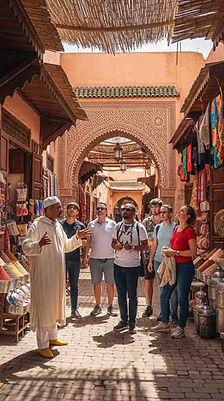
Throughout the tour, your guide explains the historical and cultural context of each souk quarter. In the textile district, you learn to distinguish hand-woven silk from synthetic blends. In the woodworking and metalwork quarters, you observe craftsmen using hand tools, chisels, hammers, lathes, to produce objects whose design vocabulary descends directly from Andalusian and sub-Saharan African traditions. This is not background information delivered at a distance. It is active, present knowledge shared while you are standing in front of the craft being discussed.
The craftsmen working in the Marrakech souks are practicing trades that have been passed through families and apprenticeship systems for generations. The maallem, the master craftsman, typically begins training as an apprentice in adolescence and spends years developing manual skills before producing finished work independently. Many of the craft techniques in use today, zellige tilework, repousse copperwork, natural-dye leather tanning, have changed little in five centuries. These are not craft traditions preserved for tourism. They are living industries producing objects that furnish Moroccan homes, palaces, and mosques. Our guide's relationships with specific craftsmen allow us to enter workshops and observe production in a way that is not possible for independent visitors.
The full-day version of this tour (8 hours) covers all the essential souk quarters plus additional areas, the carpet and textile merchants, the leather goods quarter, the musical instrument souk, and time at Jemaa el-Fna in the late afternoon as the square begins its nightly transformation. It also includes a traditional Moroccan lunch at a family-run riad restaurant in the medina — not a tourist-facing terrace, but a genuine midday service of salads, tagine, and fresh bread. The full day is appropriate for travelers who want to make significant craft purchases, since the additional time allows you to revisit stalls after having seen the full range of options available across the market.


Choose Your Day
Each itinerary below covers a different approach to the city. Pick the one that fits your available time, travel pace, and priorities.
Half Day Itinerary — 4 Hours
09:00
Meeting Point and Orientation
Your guide meets you at your accommodation or at Jemaa el-Fna square. Before entering the souks, you receive a brief orientation to the medina's layout, how the commercial district relates to the mosque, the palace quarter, and the residential areas, and a summary of what you'll see and why the souk district is organized the way it is. The medina of Marrakech received UNESCO World Heritage status in 1985. Its souk district has been in continuous commercial operation for nearly 1,000 years. Understanding this before entering it changes how you read the space.
09:30
Souk Semmarine: The Textile Gateway
You enter the souk district through Souk Semmarine, the main commercial artery. 'Semmarine' derives from the Arabic word for a type of fine textile, reflecting this quarter's historic role as the market for high-value woven goods: silk brocades, fine wool djellabas, and embroidered kaftans. Today it remains the principal entry point into the souk network, and its wide, covered passage is lined with shops selling fabric, clothing, and embroidery. Your guide explains how to identify hand-woven fabric versus machine-produced textiles, the irregularities in handloom weaving that are indicators of authentic production, and introduces the broader color and pattern vocabulary of Moroccan textile tradition, including the regional differences between Marrakech, Fes, and Tetouan weaving styles.
10:15
Souk el Attarine: Spices, Perfumes, and Apothecary
Branching off Semmarine, you enter the fragrance quarter. 'Attarine' derives from 'itr,' the Arabic word for perfume, and this souk has served as Marrakech's center for spices, fragrance, and medicinal preparations since the medieval period. The stalls here display wooden crates of hand-ground spices: whole cumin, turmeric, paprika, dried rosebuds, powdered ginger, and ras el hanout, the Moroccan mixed spice blend whose name translates as 'top of the shop' and whose recipe varies from vendor to vendor. Your guide explains how to identify genuine Moroccan saffron from the cheaper safflower substitutes that are frequently sold as saffron in tourist-facing stalls. The quarter also produces traditional cosmetics: argan oil (cold-pressed for skin, roasted for cooking), black soap (savon beldi used in hammam preparation), rhassoul clay, and kohl, preparations that have been made in Morocco for centuries and that connect directly to Andalusian and sub-Saharan trade traditions.
11:00
Souk Chouari and Souk Haddadine, Wood and Metal
Moving deeper into the medina, you arrive at the craftsmen's quarters where the medina sounds completely different, the tapping of metal hammers, the smell of cedarwood sawdust and machine oil. Souk Chouari is the woodworkers' and carpenters' quarter, where craftsmen produce cedarwood boxes, moucharabieh (traditional latticed wooden screens), carved furniture, and architectural elements using hand chisels and foot-powered lathes. The geometric inlay patterns, marquetry work using contrasting woods and bone or mother-of-pearl, encode Islamic geometric mathematics that predates Renaissance perspective drawing in Europe. Adjacent is Souk Haddadine, the ironworkers' and coppersmiths' district. Here craftsmen hammer hand-cut brass and iron sheet into lanterns, door hardware, and decorative trays using repousse technique, hammering from the reverse face to raise the pattern. Your guide explains the design vocabulary of Moroccan metalwork: the khamsa (hand of Fatima), the eight-pointed star (khatm Suleiman), and the arabesque vine, each with a specific history and symbolic meaning in Islamic decorative arts.
11:45
Souk Smata: Leather and Babouche Cobblers
The cobblers' quarter, known for the production of babouche, the traditional Moroccan slipper, is one of the most active manufacturing zones in the souk district. You watch artisans cut, stitch, and finish leather slippers by hand. The soft, unlined yellow babouche in traditional men's style; the embroidered and pointed women's version; the harder-soled contemporary variations, your guide explains the craft and material differences between them. You also learn about the tanning process: Moroccan leather is processed using traditional plant-based tanning agents and natural dye pigments (saffron for yellow, pomegranate bark for dark tones, indigo for blue), a process that takes 6-10 days per hide and produces a softer, more supple leather than the mineral-tanned alternatives produced industrially.
12:30
Optional Addition or Return
Depending on your pace and interests, the final 30 minutes can be spent revisiting any quarter of the souk, browsing independently with your guide available for context, or visiting Medersa Ben Youssef, the 14th-century Quranic school whose carved plaster, zellige, and cedarwood interior is considered one of the finest examples of Moroccan architectural ornament still standing. The medersa is a 5-minute walk from the center of the souk district.
What You Will Experience