

Jemaa el-Fna at Night: What Happens in the Medina and Souks After Dark

Updated: 22 minutes ago
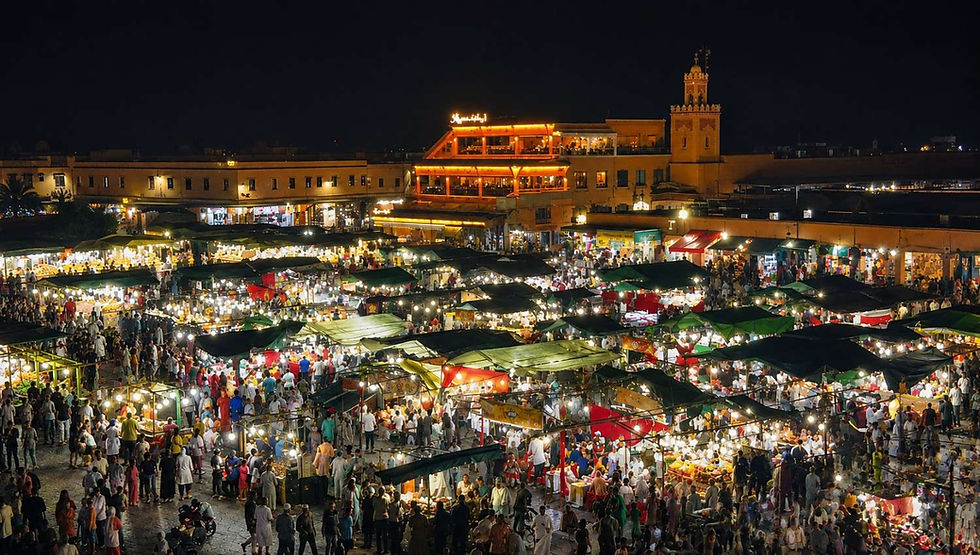
Jemaa el-Fna is one of the few places in the world that essentially rebuilds itself every evening. What stands in the square at 4 p.m. bears almost no resemblance to what stands there at 9 p.m. That single fact explains most of the confusion visitors have about what's open, what's worth seeing, and whether the medina "shuts down" once the sun goes.
It doesn't. If anything, the opposite is closer to true. But it's also worth saying upfront: there is no fixed schedule governing any of this. Marrakech doesn't run on posted hours the way a shopping mall does, and anyone looking for a clean, universal answer to "what time does it close" is going to be disappointed, because the answer shifts by season, by day of the week, by how busy the city is that month, and honestly by which particular vendor you happen to be asking.

Why There's No Single Closing Time
Jemaa el-Fna isn't a business. It's a shared public space that hundreds of independent vendors, musicians, and stallholders occupy on a rolling, informal basis, each running their own hours based on their own read of the crowd. That's the first thing to understand before asking whether it's "open" at a given hour: the question doesn't quite apply the way it would to a shop with a sign on the door.
Late afternoon is the handover period. Daytime fixtures, the snake charmers and the men posing with trained monkeys, work the tourist flow that peaks in the late morning and afternoon, and most of that scene clears out as the light fades. Henna artists are also mostly a daytime presence, though this one isn't absolute; a smaller number do still work the edges of the square into the evening, especially in the busier tourist months, so it isn't accurate to say they vanish entirely at dusk. It's just a much thinner presence than during the day.
What replaces the daytime layer is the food stall setup. Vendors start wheeling in carts, unfolding tables, and stringing bare bulbs overhead, and within thirty to forty-five minutes of sunset the square has visibly turned over. It's not staged for tourists and it's not a special event; it's simply what happens every night, and has for long enough that nobody in Marrakech treats it as remarkable.
Rough Timing, Held Loosely
With the caveat that none of this is exact, here's the general shape of the evening, based on how vendors and regulars describe it rather than any fixed rule:
Just before sunset through roughly 9 p.m. is when the square fills in. Stalls finish setting up, rooftop cafés fill with people trying to get a table with a clear view, and the first musicians start drawing crowds.
From around 9 to 11 p.m. is generally when the square is at its fullest. Nearly every stall has diners, the performance circles are at their biggest, and the souks just north of the square still have real foot traffic.
Past 11 p.m., things thin out, but thinning out doesn't mean closing. Plenty of stalls keep serving well past midnight, especially in summer, on weekends, or during any stretch when the city is busy with visitors. People who spend real time in the square will tell you they've eaten there at 1 a.m. without any trouble finding a stall still going. Whether that happens on a given night depends on the season, the day of the week, how much foot traffic is still moving through, and to some extent on which individual vendors decide it's worth staying open. There's no clean cutoff, and treating any specific hour as a hard closing time would be more definitive than reality actually supports.
What is fair to say is that the deepest lull tends to fall somewhere in the small hours before dawn, when even the latest stalls have generally wound down. But even that shifts with the season. Summer nights, when the heat keeps people outdoors well past dark, run noticeably later across the board than winter ones, and Marrakech's winters are mild enough that the seasonal difference is more about the length of the evening than about cold pushing people indoors.

The Food Stalls
This deserves real detail, because "food stalls" undersells what actually happens in the square after dark. Estimates vary, but a commonly cited figure is somewhere around fifty active stalls on a given night, each assigned a number that's posted or painted somewhere visible. Diners in Marrakech genuinely refer to stalls by number the way you'd refer to a favorite restaurant by name, and a handful, like stall number one, run by the same family for generations, have held their reputation for decades. It's worth noting that the actual number painted on a stall can run well past fifty, into the hundreds in some cases, simply because numbering isn't sequential or fully reused each night; the count of stalls actually operating at once is the smaller, steadier figure.
Some stalls are little more than a counter with a few stools; others are set up more like an open-air restaurant, with rows of tables, laminated multilingual menus, and someone standing out front trying to pull in customers. That last part is worth knowing before you go: touts working the busier stalls will call out in whatever language they think matches you, and some are more insistent than others. The general local wisdom is to treat a hard sell as a mild warning sign rather than a reason to sit down. Stalls that are already full, especially ones with people standing behind the seated diners waiting for a table, are usually full because the food and reputation earned it. An empty stall at 9 p.m., no matter how loudly someone's calling you over, is empty for a reason.

The menus across most stalls look nearly identical on paper: grilled meats and merguez sausage, couscous, a handful of tagines, mixed seafood, salads, harira soup. Snail soup, served hot from big steaming pots with a ladle of broth, is one of the more distinctive options and a genuine local staple rather than a novelty for visitors; Marrakchis eat it regularly, partly for the taste and partly for its reputation as something that settles the stomach. Sheep's head, served with cumin and salt, is available at a handful of stalls for anyone willing to try it. Bread and a small salad or two often arrive automatically once you sit down, sometimes free, sometimes for a token few dirhams, and it's worth asking or checking a posted price list before assuming anything is complimentary. Tea, similarly, may show up without being asked for and typically carries a small charge.
Prices are low by almost any standard, generally somewhere in the range of forty to eighty dirhams for a main dish. That said, overcharging happens, and it's common enough that regular visitors and locals alike recommend a few habits: confirm prices before ordering, count your dishes against what actually arrives since extra items occasionally show up on the table unordered, and double-check the final bill against what you were quoted. None of this makes the square a trap. It's closer to what you'd expect from any dense, cash-based, high-turnover market, where being a little alert serves you better than being either paranoid or completely unguarded.

One detail worth flagging if tanjia, Marrakech's slow-cooked "bachelor's stew," is on your list: it's associated with Mechoui Alley just off the square, but that alley runs on a lunch-and-early-evening rhythm, not a late-night one. Vendors there frequently sell out or are down to scraps by the time the main square's dinner rush is in full swing, so it's better treated as a midday plan than a late-night one.
Beyond the Food: What Else Is Happening in the Square
The food stalls get most of the attention, but they're only part of what's going on across the square at night, and it's worth walking the whole footprint rather than treating the stalls as the destination.
The juice stalls that line one side of the square during the day don't disappear at night either. Freshly squeezed orange juice is the obvious draw, sold for a few dirhams a glass, but the same stalls and the ones near them often carry dried fruit and nuts, dates, almonds, dried figs, and similar, sold by weight or in small paper cones, which makes for an easy, portable snack while wandering rather than sitting down for a full meal.

Music and performance fill the space around the food. Gnaoua musicians, playing metal qraqebs and the deep-toned guembri, draw circles of onlookers that can run three or four people deep. Storytellers, working mostly in Arabic or Tashelhit, continue a tradition old enough that UNESCO recognized Jemaa el-Fna in 2001 as one of the first sites anywhere designated part of humanity's intangible cultural heritage. Simpler entertainment exists too: stalls running basic games, like fishing plastic rings or balls out of water tubs for small prizes, that pull in as many local families as visitors.

Scattered around the edges of the square, on the ground rather than in fixed stalls, you'll also find individual sellers with goods laid out on mats or cloths, small artisanal items, jewelry, trinkets, and handmade odds and ends, distinct from the more organized souvenir shops that ring the square itself. It's informal, low-key selling that runs well into the evening alongside everything else.

For a wider view of it all, the cafés and rooftops ringing the square offer terraces looking out over the action, with the Koutoubia Mosque visible in the distance once it's lit. At any of these cafés, the coffee or tea is fairly ordinary; the seat is the actual product. Arriving close to sunset gets a better table than arriving at 9 p.m., when the best spots are already taken.

The Shops Right Around the Square
Beyond the market stalls inside Jemaa el-Fna itself, the buildings framing the square are lined with shops that keep their own late hours, separate from both the food stalls and the deeper souks. These include general stores, known locally as hanouts, small, packed-tight shops selling water, snacks, toiletries, and daily basics, along with a mix of places selling clothing, electronics, and phone accessories. Many of these stay open well into the evening simply because foot traffic around the square supports it, making them a reliable option if you need something practical, a bottle of water, a phone charger, without heading deep into the medina.
The Souks: Where "Open" Gets Complicated
North of the square, the souks (Semmarine, Rahba Kedima, Souk Smata, Souk Cherratin, Souk el Attarine, and others) form a dense network of covered lanes, and this is where visitors most often get uncertain answers.
The general pattern: shops along the main routes, particularly Souk Semmarine, the largest market in the medina, stay open as long as people are walking through, which in practice often means until around 10 p.m. There's no fixed closing hour; vendors are working, not operating on a schedule, so the shutters come down when street traffic drops off, not before.
The further into the network you go, into smaller side alleys and specialty souks that see less foot traffic after dark, the earlier things tend to close, often somewhere around 9 p.m. This isn't uniform and isn't strictly predictable. It's simply less profitable to stay open on a quiet side lane once nobody's walking past.
Rahba Kedima, the old spice and apothecary square just off Semmarine, functions as a kind of junction between souks and tends to stay active a little later than its immediate side streets.

Within this network, it's worth knowing the difference between a souk and a qisariya, since the two get used loosely by visitors but mean somewhat different things locally. A souk, broadly, is an open street market, a lane or cluster of lanes lined with stalls, often organized loosely by trade, spices in one stretch, leather in another, and so on. A qisariya (also transliterated as kissaria) is something more specific: a covered, gated inner market, historically the section of the medina where higher-value goods like fabric, clothing, and finer imported items were sold, often lockable and more tightly controlled than the open souk lanes around it. In Marrakech, several qisariyas still operate as covered clusters of small shops within the broader souk network, generally leaning toward clothing and textiles, and some do stay active into the evening, though as with the souks generally, how late depends on foot traffic on a given night rather than any fixed hour.
There's a small practical upside to browsing the souks in the last hour before closing: vendors ready to pack up for the night are sometimes more open to negotiating on price than they would be mid-afternoon. It isn't a guarantee, and nobody should expect a steep discount purely for showing up near closing time, but it's a real dynamic that shopkeepers themselves will acknowledge.
Lanterns in particular are worth seeing at night rather than during the day. The punched-metal designs that look plain in daylight throw intricate patterns of light once lit in a dim alleyway, which is largely the point of buying one.
Le Prince: The Passage Locals Actually Use
One route worth knowing by name is Passage Prince Moulay Rachid, known to locals simply as Le Prince. It runs off the square, starting near the main post office, and cuts south through the medina toward El Badi Palace and the Saadian Tombs, functioning as a genuine walking artery rather than a tourist detour. It's wide by medina standards and busy well into the night, lined with affordable rooftop restaurants, coffee shops, and small stalls selling less traditional souvenirs, toys, cheap clothing, and similar goods, alongside places doing quick, inexpensive food. A shawarma wrap here for around twenty-five dirhams is typical of the price point. Both locals and tourists use it heavily after dark, partly because it's a genuine shortcut between the square and the southern medina, and partly because it has its own late-night energy independent of Jemaa el-Fna itself.

The Neighborhoods Around the Square
The streets radiating out from Jemaa el-Fna each have a distinct character, and treating the whole area as one undifferentiated "medina" misses a lot of what's actually there. This part of Marrakech functions like a small city folded inside the larger one, with different quarters known for different things.
Rue Riad Zitoun el Kdim runs southeast toward Place des Ferblantiers and the Mellah, the old Jewish quarter, lined with small bazaars, tea rooms, artisan workshops, and restaurants tucked down alleyways. It's one of the busier connecting streets after dark, functioning almost as an extension of the square itself.
A short distance from it, Rue Riad Zitoun el Jdid runs a parallel route and has become known for a cluster of well-regarded restaurants and boutique riads, some occupying converted historic mansions.
North and slightly west of the square, the Mouassine quarter has developed a reputation as one of the more fashionable pockets of the medina, home to concept stores, art galleries, and a growing number of bars and restaurants alongside the older workshops where leather, wood, and metal are still worked by hand. Shops here, and along nearby Rue Dar el Bacha, sometimes stay open later into the evening than the deeper souk alleys, particularly during busier tourist months.

Southeast toward the Mellah and Place des Ferblantiers, the character shifts again, with shops leaning toward silver jewelry and antiques and a run of restaurants and rooftop bars overlooking the square. This is also where a lot of Marrakech's rooftop nightlife scene sits, since the flat-roofed architecture throughout the medina means terraces are everywhere, stacked one above another, each with its own version of the same view.
None of these neighborhoods are far from Jemaa el-Fna in distance; most are a five- to fifteen-minute walk. But they don't share a single identity, and lumping "the medina at night" into one description misses how differently each pocket of it behaves once the sun is down.
The Honest Answer
If the question is simply whether there's anything to do or see at 8 p.m., the answer is a clear yes, and the square is arguably at its most alive somewhere between 9 and 11 p.m., once the food stalls are in full swing and before the crowd starts to thin. The souks stay workable for browsing until somewhere around 9 or 10 p.m. depending on how far into the network you go, with the main routes like Souk Semmarine holding out the longest. Past midnight, both the square and the souks generally wind down, though not on any fixed schedule, and enough stalls stay open past that point that "everything's closed by midnight" is more a rough tendency than a rule. The deepest quiet, when it actually comes, tends to land somewhere in the small hours before dawn, not at the stroke of any particular hour.


Comments