
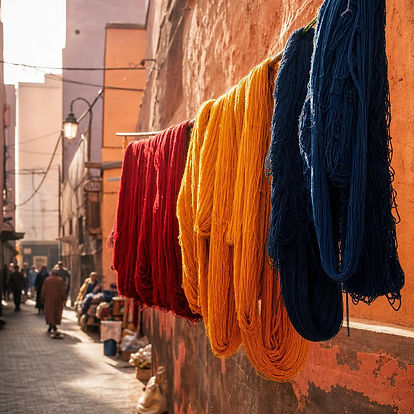
The Dyers' Souk
Souk Sebbaghine
Tucked near the Mouassine entrance to the Medina, Souk Sebbaghine, often called Souk des Teinturiers by French speakers and international visitors, is Marrakech's traditional wool and textile dyeing souk. It's one of the Medina's oldest specialized trades, and one of its most visibly threatened.
Origins of the Craft
The dyeing trade practiced here traces its roots back to Fez, where the craft originated before taking hold in Marrakech and being passed down locally through the generations. The souk's very name comes directly from the trade practiced in it: dyeing wool, silk, and thread.
One artisan who has worked in the souk for over three decades, having joined the trade as a boy, helping his father on weekends when school was out, recalls being told that at its peak, this souk was lined with roughly 80 shops, all engaged in dyeing wool and textiles. Skeins of freshly dyed yarn and fabric hung to dry throughout the souk, and the sight of full color, reds, saffron yellows, indigo blues, draped everywhere was, by his account, part of what made the souk a genuine attraction for visitors even decades ago.
Who Uses the Souk
The dyers' remaining customer base today is largely rural rather than touristic. Wool producers and weaving cooperatives from regions like Azilal, Beni Mellal, and Khenifra travel to Marrakech specifically to have their raw wool dyed here before turning it into carpets and blankets back home. Some bring modest quantities, 10 or 12 kilos at a time, while larger cooperatives may bring in 100 to 200 kilos at once, visiting only periodically to drop off wool and collect finished, dyed batches.
Visiting Souk Sebbaghine
-
The souk sits near the Mouassine mosque and Bab Doukkala approach to the Medina, distinct from the busier central spine of Semmarine–Attarine.
-
Because so few working dye-houses remain, this is not a large shopping souk, it's better experienced as a glimpse into a genuinely traditional, hands-on craft rather than a retail destination.
-
If you're interested in naturally dyed wool, carpets, or textiles, buying directly from the working dyers supports the artisans keeping this centuries-old trade alive.
-
Look for the hanging skeins of freshly dyed wool drying overhead, still one of the most photographed sights in this part of the Medina, even as the number of active workshops has shrunk.