
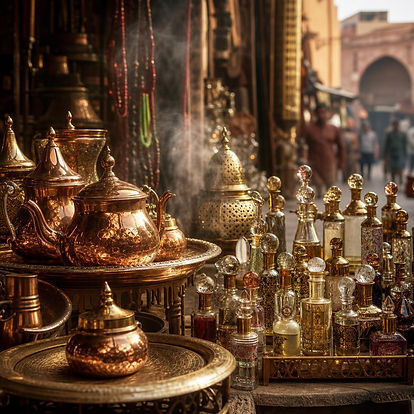
The Perfume, Spice, and Copper Souk
Souk El Attarine
Souk El Attarine is one of the oldest and most storied souks in the Marrakech Medina, and its name tells you exactly what it once was: a market of attar, perfume and aromatics. But the full story is a little more layered than the name alone suggests, because this souk has historically been home to two overlapping trades: perfumery and copperware.
One Souk, Two Traditions
According to artisans who have worked here for generations, the historic Attarine district actually combined three trades under one roof: perfume and incense, thread, and copperwork, which is why you'll sometimes hear this area referred to by two names, Souk El Attarine and Souk En-Nhass (the copper souk). They occupied the same streets and grew up together, and locals who worked the area often describe them as effectively one souk with two specialties.
The copperware side of the market was, by all accounts, once the finest in the city, sourcing pieces you couldn't find anywhere else in Marrakech. The perfume side specialized in distilling natural essences: rosewater, orange blossom water, vinegar-based extracts, and other traditional distillations still produced by hand using age-old methods passed down within families.
The Wedding Trade That Built the Souk
For much of the 20th century, this souk had a very specific and very important customer: the Marrakchi bride. Tradition held that a woman preparing for her wedding needed to furnish her new household with a full set of copperware, trays, teapots, glasses, serving pieces, and Souk El Attarine was the place to buy it all. A bride's first stop in preparing her home was here, and no household was considered properly equipped without a full set from the coppersmiths of Attarine.
That tradition has faded substantially. Modern brides increasingly skip the full copperware trousseau, and the artisans who remain say the copper trade has dropped off sharply compared to its peak, some estimate the copper business alone has fallen by the vast majority from what it once was. What used to be an essential wedding purchase is now a niche or nostalgic one.
Who Buys Here Now
Today, it's largely an older generation, Marrakchis who remember the tradition, who still come to Souk El Attarine specifically for rosewater, orange blossom water, and copperware. Demand for the natural distillations spikes seasonally: the souk sees its busiest trade during the sacred months of Shaaban and Ramadan, when households buy rosewater and orange blossom water in bulk for traditional sweets and hospitality.
Copperware today leans heavily toward the antique and restored rather than the newly made. Artisans buy old teapots and vessels, some 60, 70, even 80 years old, and refurbish them: polishing, repairing, and putting them back into circulation, since demand for brand-new copper pieces has thinned. Much of the copper stock sold in the souk is actually sourced from workshops in Fez rather than made locally in Marrakech.
A Living, If Fragile, Craft
The perfume side of the trade is often passed down within families as an inheritance, sons learning distillation techniques directly from their fathers, much as this souk's own artisans describe having done. It's considered a dignified, almost sacred craft, distinct from disposable retail; those who practice it speak of it as something worth protecting so it isn't lost to the next generation.
The physical infrastructure of the souk, however, has struggled. Some shopfronts have closed permanently as older shopkeepers pass on and it becomes harder to justify the cost of maintaining or reopening a stall in a niche trade. Renovation of some of the older, damaged storefronts has been slow, a source of frustration for the artisans who remain and who worry that the souk's traditional character is being worn down by neglect even as tourism keeps the area lively.
What to Look For as a Visitor
-
Rosewater, orange blossom water, and other traditional distillations, sold in small bottles perfect for gifting.
-
Restored antique copper teapots, trays, and glasses, a good option if you're after something with real history rather than a mass-produced souvenir.
-
The lingering scent of incense and spice that still defines parts of the souk, even where the stalls themselves have diversified.
Note that many shops here now also carry general metalwork, lanterns, and tourist-oriented brassware alongside the traditional perfume and copper trades.