

Marrakech’s Parks Plan Stretches From Bab Doukkala to Mhamid

Updated: Oct 23
A seven-hectare garden taking shape on Bab Doukkala’s former wholesale market, a 65-hectare urban forest nearing the end of construction in Mhamid and a nine-hectare oasis garden that has yet to break ground: Marrakech’s green-space programme is not one project but a patchwork of works moving at markedly different speeds.

The clearest citywide account appeared on 12 October in an official publication of the Authenticity and Modernity Party (PAM). Ibrahim Al-Sabbar’s report draws on the fifteenth interim review of the municipality’s 2023–2028 action programme and, usefully, separates active building sites from projects still on the drawing board.
Bab Doukkala’s old market site becomes a major public-space project
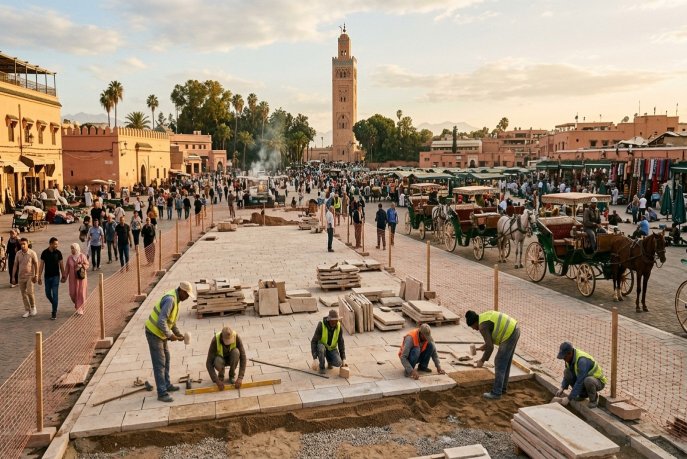
Work is under way on roughly seven hectares at the former wholesale market in Bab Doukkala. The plans combine themed planting, sports and recreation facilities and a cultural area. A car park for about 1,500 vehicles and a separate stand for horse-drawn carriages are also envisaged, although neither is available yet and no opening timetable has been announced.
That scheme sits within a wider reshaping of Bab Doukkala. The nearby Almoravides Garden is also under renovation, while pedestrian spaces and new street furniture are planned around the district. The three elements — garden, parking and public realm — amount to a substantial intervention at one of the main approaches to the Medina, but the programme does not yet set out final traffic arrangements or public-access dates.
Mhamid has the programme’s largest green space
In Mhamid, Borj Zitoun Square was reported to be about 85% complete in the October review. The percentage describes construction progress, not an opening: there is still no confirmed date for the square to enter public use.
The larger Mhamid story lies at Maataallah, between Asskejour, Azli and Iziki. Kech24 reported on 12 October that the 65-hectare urban forest had reached about 95% completion. Landscaping, planting and basic infrastructure were described as finished, with sports equipment, children’s play installations and street furniture moving through fitting and handover. The 65-hectare figure also appears in Mayor Fatima-Zahra Mansouri’s published record of municipal projects.
The urban forest is therefore much further advanced than several projects elsewhere in the programme, but it should not yet be treated as an operating park. A construction percentage and a handover phase do not establish public access, opening hours or completed safety checks.
Four hectares in Hay Charaf, nine in Sidi Youssef Ben Ali
At Hay Charaf, the programme covers the rehabilitation of about four hectares of green space and a connection to the treated-water network. That irrigation detail is more than technical housekeeping in a water-stressed city: it will shape whether the planting can be maintained after the initial works. No commissioning date for the connection was given.
The Hassan II Oasis Garden in Sidi Youssef Ben Ali is planned on nine hectares, with four distinct themed gardens. It was still being prepared for the start of on-site work when the interim review was published. The project is substantial, but it remains a proposal moving towards construction rather than a park nearing its opening.
Historic gardens and early-stage plans
Arsat El Bilk, beside Jemaa el-Fna, is being refurbished with reorganised paths, updated lighting, equipment and fountain installations. The programme set 30 October 2026 as the expected date for completing the works. That remains a works target, not a confirmed reopening announcement.
El Harti Garden is at an earlier stage. Its proposed renovation would introduce automated irrigation and weather-monitoring stations under the Marrakech Sustainable City programme, but the new systems are not yet installed and no construction or reopening date has been published.
Technical studies are also planned for Hammane El Fatouaki Garden and for a garden on the former date-market site in the Medina. Separate proposals would create public celebration spaces on Mohammed VI Avenue and in El Azzouzia. These are the least advanced parts of the portfolio: studies and intentions, rather than active public amenities.
The programme’s geography is as important as its scale. Mhamid, Sidi Youssef Ben Ali, Hay Charaf and El Azzouzia appear alongside the better-known central gardens, spreading investment well beyond the city’s established visitor circuit. For now, however, the map is more reliable than the calendar. Most of these spaces still require a separate public-opening notice before they can be treated as finished parks.
Cover: real photograph of the existing Jnan El Harti garden, one of the named parks in Marrakech's 2023–28 landscaping programme, published by the Marrakech municipal government in June 2026. The photograph does not depict new or completed renovation works. Municipal photograph.
Comments